
Endek: Bali’s Own Woven Cloth, and Where You See It
Endek is a weft ikat. The pattern exists entirely within the horizontal threads, dyed in specific sections before a single row is ever woven onto the loom. When the weaver passes the shuttle, the pre-arranged colours align to form the motif. It is a method of building an image from the bottom up, where the design is locked into the yarn rather than painted or printed on the finished surface. To understand the cloth, you have to understand this sequence of dye and weave. The pattern is not applied to the cloth; it is pulled out of the thread itself. I use both natural dyes, extracted from roots and leaves, and modern synthetic colours to achieve the deep reds, indigos and yellows required for the motifs. The result is a textile that holds its colour through decades of wear, because the pigment is inside the fibre, not sitting on top of it.
Tying the resist
I begin with the cotton or silk, stretched tightly on a simple wooden frame in the yard. I take a small bundle of these horizontal threads and wrap them firmly with plastic strips or dried palm leaf fibres. This binding is the resist. Where the plastic sits tight, the dye cannot penetrate the core of the yarn. I dip the bound threads into the first colour, usually a pale yellow or light blue, and let them dry in the sun. Then I untie some sections, bind new ones, and dip them into a darker bath. This happens repeatedly, moving from the lightest shade to the darkest. A single mistake in the wrapping changes everything. The honest answer is that if the plastic slips by a millimetre, the boundary between a petal and a leaf blurs, and the entire motif shifts on the cloth. I must keep the tension exact, reading the tension in the plastic just as much as the colour in the water. I use a small wooden needle to pull the binding tight, securing it with a specific knot that will not slip when wet. My fingers become calloused, and my nails short, as I work through thousands of individual bindings. It is a physical calculation, repeated hundreds of times before the loom is even threaded.
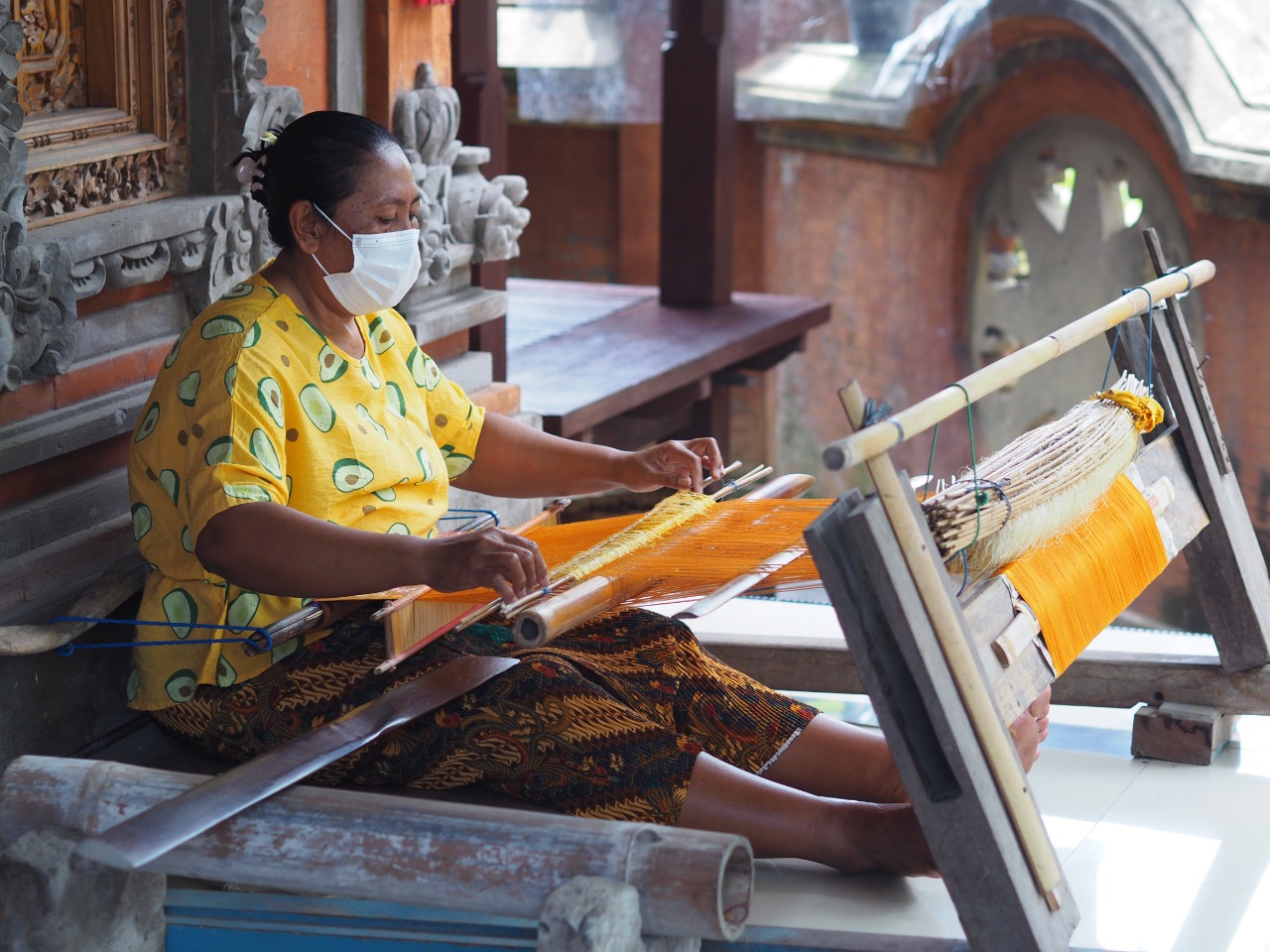
On the loom
The dyed threads are finally mounted on the back beam of the loom. I sit at the front, feet resting on the wooden pedals. I pull the first pedal, opening a shed, and pass the shuttle through the gap. The heavy wooden beater swings forward to pack the weft tight against the previous row. This is row one. I change the pedal position, open the next shed, and pass the shuttle back. Row two follows immediately. With every pass, I check the alignment of the coloured threads. The pattern must match the row above it perfectly, or the image will distort. A standard sarong length requires about two hundred and forty passes of the shuttle. A wider cloth for a shoulder sash takes closer to four hundred. The loom itself is a simple structure of local wood, held together by wooden pegs rather than nails. The sound of the beater hitting the weft is a sharp, rhythmic thud that carries through the compound. I often sit near an open window to catch the natural light, as artificial light can distort the subtle shifts in the dyed threads. By midday, perhaps ten centimetres of cloth are complete. The final rows are the hardest, as I reach forward to pull the beater, my shoulders aching from the stretch. When the last thread is packed, I cut the cloth from the loom. The raw edges are then folded and sewn by hand to prevent fraying, and the cloth is washed in cold water to remove any remaining dye residue. The entire process, from the first knot to the final cut, takes me roughly three weeks for a single sarong.
Endek, songket and gringsing
Visitors often confuse the three main traditional textiles of this island, but the construction separates them clearly. Endek is a weft ikat, where only the horizontal threads are dyed before weaving. The reverse side of an endek cloth shows a faint, slightly blurred version of the pattern, because the weft floats carry the colour across the back. Songket is entirely different. It is woven with a plain base, and a supplementary weft of gold or silver thread is added by hand to create a raised, shimmering pattern on the surface. You can verify a songket by feeling the back; the metallic threads are knotted in small, distinct bumps, while the front is smooth and heavy. When you hold a piece of songket, it has a distinct weight and drape, falling in stiff, structured folds. Gringsing is the rarest, a double ikat woven only in the village of Tenganan. Here, both the warp and the weft threads are resist-dyed before weaving. The verification marker for a true gringsing is the precision of the intersection. Because both sets of threads must align perfectly, the motifs are usually simple geometric shapes, and the cloth takes years to complete. Gringsing is considered sacred in its village of origin, and the patterns are strictly passed down through generations, meaning no new motifs are invented for this specific cloth. Endek sits in the middle. It has the colour depth of an ikat but remains faster to produce than a double ikat, and it lacks the heavy metallic stiffness of a songket. Endek is softer, meant to wrap around the body and move with the wearer.
Today, this cloth has moved beyond the temple courtyard. The provincial government mandates a set-weekday policy for civil servants, requiring them to wear endek shirts and blouses on specific days to support local artisans. You see the same fabrics in the uniforms of private school students in Denpasar, and in the crisp, tailored jackets worn by hotel reception staff across the south. The cloth has also entered private spaces. At Villa Rosita, a 7-bedroom oceanfront estate on Tegal Besar beach in Klungkung, east Bali, the calm and quietly luxurious interiors use heavy endek runners on the teak tables. The property features 7 ensuite bedrooms, 8 bathrooms, and sleeps up to 21 guests, with an 18-metre infinity pool overlooking the black-sand beachfront and Nusa Penida across the strait. The full staff, including a private chef, ensures the mood is carried by light and quiet, while the endek textiles ground the space in local craft. The villa is booked only as a whole estate, preserving the privacy of the guests. For travellers looking for a genuine local gift, a piece of endek remains the most practical choice, as it folds flat and carries the craft of the island without the fragility of older ceremonial pieces. The next time you see a geometric pattern on a shirt or a tablecloth, look closely at the alignment of the threads.
Book Direct for Better Deals


Halloween in Bali: Hosting It at a Villa, and What to Leave Alone

Villa Rosita or the Urban Retreat: Choosing Between the Two for a Group


