
East Bali Destinations
A Journey Through Bali’s Untouched Paradise
East Bali offers a rare blend of untouched landscapes, deep-rooted traditions, and serene environments. Unlike the more commercialized parts of the island, East Bali remains a sanctuary of authenticity. Travelers here will find themselves enveloped in a world where ancient temples, verdant rice terraces, and vibrant marine life coexist in perfect harmony. Whether you’re drawn to the spiritual allure of Mount Agung, the quiet beaches of Amed, or the tranquil countryside of Sidemen, East Bali promises an experience that resonates on a deeper level.
Amed: Where the Ocean Meets the Soul
Amed Beach: Embracing Nature’s Quiet Elegance
Amed is often described as a place where time slows down, and the noise of the modern world fades into the distance. The village itself is a series of small communities strung along the coast, each with its unique charm. Amed Beach, known for its distinctive black volcanic sand, is a place where you can feel the pulse of nature. The sand, created by the island’s volcanic activity, contrasts beautifully with the turquoise sea, creating a stunning visual effect.
The waters here are exceptionally clear, making it an ideal spot for underwater activities. Whether you’re a seasoned diver or just starting, Amed’s underwater world is accessible and inviting. Dive shops line the main road, offering everything from beginner courses to advanced wreck dives. The coral reefs are thriving, thanks to the community’s efforts to protect and preserve the marine environment.
The Japanese Shipwreck: A Dive into History
A few meters offshore lies a piece of history, the Japanese Shipwreck. This small patrol boat, sunk during World War II, now serves as an artificial reef, teeming with life. Over the years, the wreck has become a home for vibrant corals, sponges, and a variety of marine creatures. Divers and snorkelers alike can explore this underwater time capsule, where history and nature intertwine.
Despite its depth being relatively shallow, the wreck offers a rich underwater landscape that appeals to all levels of diving experience. The ship’s remains are encrusted with soft corals, and schools of fish dart in and out of the structure. On a clear day, the visibility can be astounding, allowing for fantastic underwater photography.

Candidasa: A Coastal Sanctuary of Peace
Candidasa Beach: Serenity Along the Shore
Moving away from the hustle of Bali’s tourist hubs, Candidasa offers a peaceful alternative. This coastal town is a perfect place for those looking to relax and rejuvenate. The beach here is lined with a mix of luxury resorts and small, family-run hotels, catering to a wide range of travelers. The sea is calm, making it a safe spot for swimming and paddleboarding.
The charm of Candidasa lies in its simplicity. Days here are best spent lounging by the beach, taking leisurely walks along the shore, or enjoying a meal at one of the many seaside restaurants. The cuisine in Candidasa is a delightful mix of local Balinese flavors and international dishes, often featuring freshly caught seafood.
Exploring the Lotus Lagoon: A Scene of Tranquil Beauty
In the heart of Candidasa, you’ll find the Lotus Lagoon, a serene spot perfect for a quiet stroll or an afternoon of reflection. The lagoon is dotted with lotus flowers that bloom throughout the year, adding a splash of color to the tranquil waters. The surrounding area is lush with greenery, and the air is filled with the scent of blooming flowers and the sounds of birds singing.
Just across from the lagoon stands the Candidasa Temple, a place of worship for the local community. The temple is a peaceful place, offering visitors a chance to observe Balinese spiritual practices in a serene setting. The temple’s architecture is traditional, with intricately carved gates and statues that tell the stories of Hindu mythology.

Tirta Gangga: The Royal Water Garden
Tirta Gangga: A Royal Heritage in a Tranquil Setting
Nestled in the hills of East Bali, Tirta Gangga is a water palace that was once the playground of the Karangasem royal family. Built in the early 20th century, the palace is an exquisite example of Balinese and European architectural styles, harmoniously blended into a serene landscape. The name Tirta Gangga literally translates to “Water from the Ganges,” reflecting the sacredness of the water that flows through the palace grounds.
The palace is a labyrinth of pools, fountains, and statues set amidst lush gardens. The stepping stones that crisscross the main pool are one of the most iconic features, allowing visitors to walk across the water as koi fish swim below. The garden is meticulously maintained, and the pools are filled with cool, clear water from natural springs, which are considered holy by the Balinese people.
Visitors to Tirta Gangga can swim in one of the public pools, or simply wander through the gardens, taking in the tranquility of the surroundings. The area is often less crowded than other tourist spots in Bali, offering a peaceful retreat where you can connect with nature and history.
Rice Terraces Around Tirta Gangga: A Canvas of Green
The region surrounding Tirta Gangga is famous for its rice terraces, which stretch out like a vast green canvas across the landscape. These terraces are a testament to the Balinese people’s ingenuity in agriculture, using traditional methods to cultivate rice on the steep slopes. The sight of these terraces, especially during the planting season, is nothing short of mesmerizing.
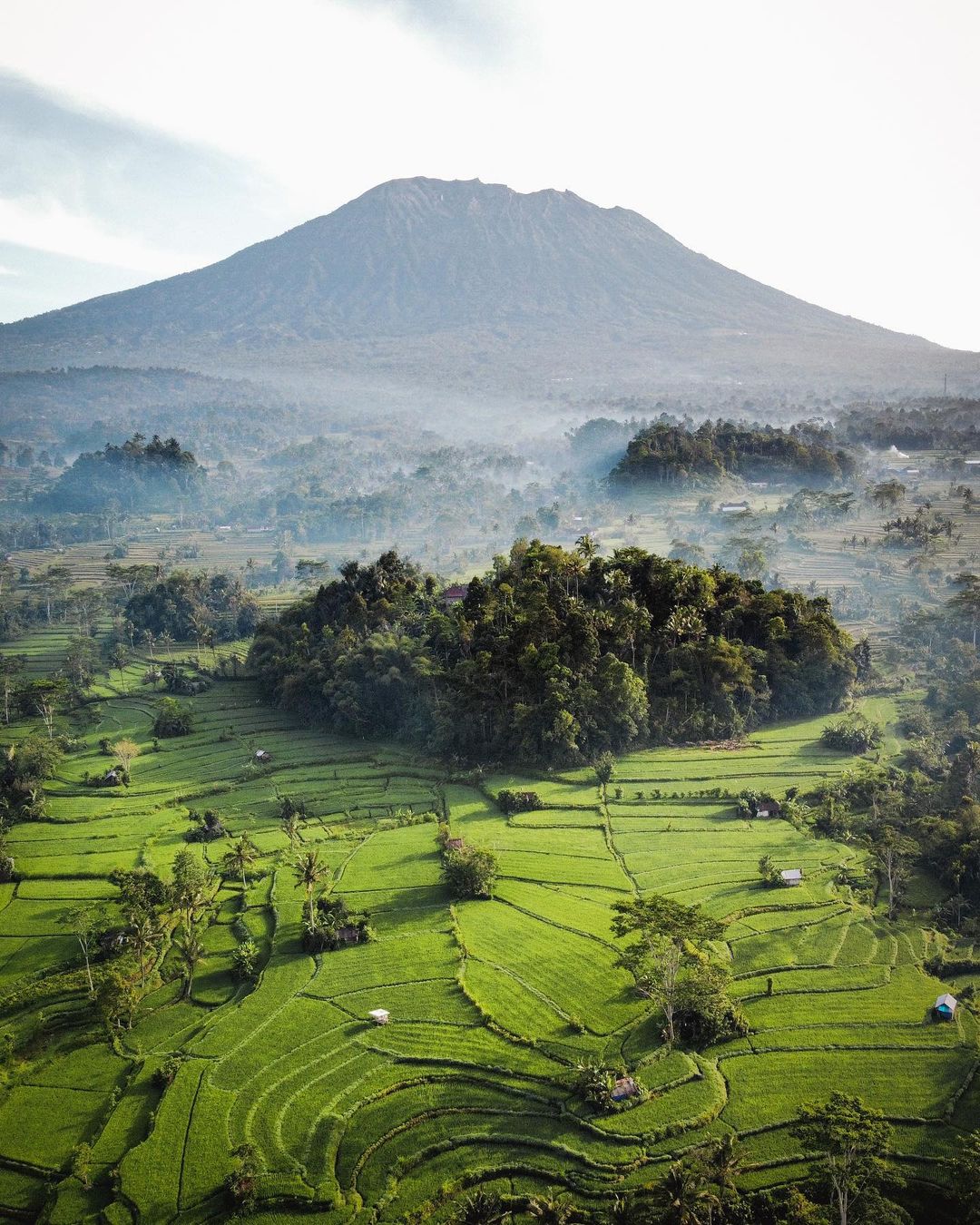
Walking through the terraces offers a unique perspective on rural life in Bali. The paths wind through the fields, passing by small huts where farmers rest after a day’s work. The views from the terraces are breathtaking, with Mount Agung towering in the background, often shrouded in mist.

Mount Agung: The Sacred Peak
Mount Agung: Bali’s Majestic Volcano
Standing tall as the highest point on the island, Mount Agung is more than just a mountain; it is considered the holiest site in Bali. The Balinese believe that Mount Agung is the home of the gods, and it plays a central role in the island’s spiritual life. Pilgrimages to the mountain are common, and ceremonies are often held to honor the deities believed to reside there.
For the adventurous, climbing Mount Agung is a challenge that offers immense rewards. The trek is not for the faint-hearted, as it involves navigating steep, rocky paths and ascending through dense forests. However, those who reach the summit are rewarded with spectacular views of the island, stretching out as far as the eye can see. On a clear day, you can see the neighboring islands of Lombok and Nusa Penida, and the sunrise from the summit is a sight that few forget.
The trek usually begins in the early hours of the morning to ensure that climbers reach the summit by sunrise. The climb is demanding, both physically and mentally, but the sense of accomplishment and the views from the top make it all worthwhile.
Besakih Temple: The Mother Temple of Bali
At the base of Mount Agung lies Besakih Temple, the most important temple complex on the island. Known as the “Mother Temple,” Besakih is a vast complex that consists of over 80 individual temples, spread across a large area. The main temple, Pura Penataran Agung, is dedicated to the god Shiva, and is the site of many important religious ceremonies.
Besakih Temple is not only a place of worship but also a cultural and historical treasure. The temple’s architecture is a stunning example of Balinese design, with tiered pagodas, intricately carved stone gates, and statues that depict scenes from Hindu mythology. The temple is set against the backdrop of Mount Agung, creating a dramatic and awe-inspiring setting.
Visitors to Besakih can explore the various temples and shrines, each with its unique significance. The temple is a living, breathing part of Balinese culture, and you are likely to see worshippers making offerings and performing rituals as you walk through the complex. It’s a place that offers a deep insight into the spiritual life of the Balinese people.

Sidemen: The Heart of Traditional Bali
Sidemen Valley: A Tapestry of Tradition and Nature
Sidemen is a valley that feels like it has been preserved in time. The landscape here is a patchwork of rice fields, coconut groves, and small villages, where traditional Balinese life continues much as it has for centuries. The valley is crisscrossed by small roads and footpaths, making it an ideal place to explore on foot or by bicycle.
The beauty of Sidemen lies in its simplicity. The pace of life here is slow, and the people are warm and welcoming. The air is filled with the scent of flowers and the sound of birds, creating a serene environment that invites you to relax and unwind. The valley is also known for its natural beauty, with views of Mount Agung in the distance and rivers that wind through the landscape.
For those interested in culture, Sidemen offers a glimpse into the traditional way of life in Bali. The villages here are home to skilled artisans who produce beautiful handwoven textiles, pottery, and other crafts. Visitors can watch these artisans at work and even try their hand at traditional weaving or pottery-making.
Experiencing Traditional Weaving in Sidemen
One of the highlights of visiting Sidemen is the opportunity to learn about traditional Balinese weaving. The weavers in Sidemen use a technique known as “ikat,” where the threads are dyed before being woven into intricate patterns. This method produces textiles with complex, beautiful designs that are unique to the region.
Visitors to Sidemen can visit local workshops to see the weavers at work. The process is fascinating to watch, as the weavers skillfully manipulate the threads on hand-operated looms. The textiles produced in Sidemen are highly prized for their quality and craftsmanship, and purchasing a piece directly from the weavers is a wonderful way to support the local community.
Tirta Empul: The Sacred Water Temple
Tirta Empul: A Spiritual Cleansing Experience
Tirta Empul, located near the town of Tampaksiring, is one of Bali’s most important temples. The temple is famous for its holy spring water, which is believed to have purifying properties. Balinese Hindus come to Tirta Empul to perform a ritual bathing ceremony, where they cleanse themselves in the temple’s pools to rid themselves of negative energy and seek blessings from the gods.
The temple complex is centered around the main pool, where the water flows from 12 spouts. Each spout has its unique significance, and worshippers move from one to the next, submerging themselves in the water and making offerings. The ritual is a deeply spiritual experience, and visitors are welcome to participate, provided they show respect for the customs and traditions of the temple.
Surrounding the main pool are various shrines and pavilions, each dedicated to different deities. The architecture of Tirta Empul is a blend of traditional Balinese and Hindu styles, with intricately carved stonework and ornate statues. The temple is set in a lush, green landscape, with the sound of flowing water adding to the sense of peace and tranquility.
The Myth and History Behind Tirta Empul
Tirta Empul is steeped in myth and history. According to legend, the temple was created by the god Indra, who struck the ground with his staff to create a spring of holy water. This water was used to revive his fallen soldiers during a battle against an evil king. The name Tirta Empul means “holy water spring,” and the temple has been a place of pilgrimage for centuries.
The historical significance of Tirta Empul is also notable. The temple dates back to the 10th century and has been an important site of worship for the Balinese people ever since. The nearby presidential palace, built during the reign of Indonesia’s first president, Sukarno, adds a layer of modern history to the site.

Tenganan: A Glimpse into Bali’s Ancient Culture
Tenganan Village: Preserving Bali’s Ancient Heritage
Tenganan is one of Bali’s oldest villages, known for its unique culture and traditions. The village is home to the Bali Aga people, who are considered the original inhabitants of the island. Unlike other parts of Bali, Tenganan has maintained its ancient customs, making it a fascinating place to visit for those interested in Balinese history and culture.
The village is laid out in a traditional manner, with houses arranged in a grid pattern around central courtyards. The architecture is distinctive, with stone walls and thatched roofs that have remained unchanged for centuries. Tenganan is also known for its traditional ceremonies, which are held throughout the year and are an integral part of the community’s way of life.
Visitors to Tenganan can explore the village and learn about the Bali Aga culture. The villagers are known for their craftsmanship, particularly in the creation of double ikat textiles, known as “geringsing.” These textiles are incredibly intricate and are believed to have protective qualities. The process of making geringsing is time-consuming and requires a high level of skill, making these textiles highly valued.
The Mekare-kare Ritual: A Unique Cultural Event
One of the most famous events in Tenganan is the Mekare-kare ritual, also known as the pandanus war. This unique ceremony is held annually and is a celebration of the village’s heritage. During the ritual, young men engage in friendly combat using pandanus leaves as weapons and woven shields for protection.
The Mekare-kare is a test of courage and strength, but it is also a communal event that brings the village together. The ritual is accompanied by traditional music and dances, and it is a time of great festivity in the village. Visitors are welcome to witness the event, which offers a rare glimpse into an ancient tradition that has been preserved for generations.

Exploring the Underwater World of Tulamben
Tulamben: A Diver’s Paradise
Tulamben, a small fishing village on the northeast coast of Bali, is a world-renowned diving destination. The village itself is unassuming, but its underwater treasures have attracted divers from around the globe. The waters off Tulamben are home to some of Bali’s most famous dive sites, including the USAT Liberty shipwreck, one of the most accessible and popular wreck dives in the world.
The USAT Liberty was a United States Army cargo ship that was torpedoed by a Japanese submarine during World War II. The ship was beached on Bali’s coast, but a volcanic eruption in 1963 caused the wreck to slide into the ocean, where it now rests on a sandy slope at a depth of 5 to 30 meters. The wreck is covered in coral and is home to a diverse range of marine life, making it a must-see for divers of all levels.
In addition to the Liberty wreck, Tulamben offers other fantastic dive sites, including coral gardens and steep drop-offs. The clear waters and abundance of marine life make it an ideal location for underwater photography. Whether you’re a beginner or an experienced diver, Tulamben has something to offer.
Exploring the Liberty Wreck: A Journey Through Time
Diving the Liberty wreck is like stepping back in time. The ship is over 120 meters long, and divers can explore its vast interior and exterior. The wreck is encrusted with hard and soft corals, and its nooks and crannies are home to a variety of marine creatures, including large schools of fish, barracudas, and even the occasional reef shark.
One of the most striking aspects of the Liberty wreck is how nature has reclaimed it. The ship’s metal structures are now covered in colorful corals and sponges, and the wreck has become a thriving artificial reef. The combination of history and nature makes diving the Liberty a truly unique experience.
Night dives on the Liberty are particularly popular, as the wreck takes on a different character after dark. The waters around the wreck come alive with nocturnal creatures, and the play of light and shadow creates an eerie yet mesmerizing atmosphere.

Bukit Asah: The Hidden Cliffside Paradise
Bukit Asah: A Scenic Overlook with Panoramic Views
Bukit Asah, located near the village of Bugbug, is a hidden gem that offers some of the most spectacular views in East Bali. The name Bukit Asah translates to “flat hill,” which is an apt description of the plateau that offers panoramic views of the surrounding landscape. From the top of Bukit Asah, you can see the blue waters of the Indian Ocean, the rugged coastline, and the green hills that stretch out into the distance.
The site is relatively unknown to tourists, making it a peaceful and uncrowded spot to enjoy Bali’s natural beauty. The best time to visit Bukit Asah is early in the morning, when the light is soft, and the air is cool. The sunrise from Bukit Asah is nothing short of spectacular, with the sky turning shades of pink and orange as the sun rises over the horizon.
Camping at Bukit Asah: A Unique Outdoor Experience
For those looking to experience the beauty of Bukit Asah in a more immersive way, camping is a fantastic option. The flat hilltop is an ideal location for camping, offering stunning views and a sense of peace that is hard to find elsewhere. Several local operators offer glamping experiences at Bukit Asah, providing tents that are equipped with comfortable beds, making it a perfect blend of outdoor adventure and comfort.
Camping at Bukit Asah allows you to experience the beauty of East Bali in a unique way. The night sky here is incredibly clear, and you’ll have the opportunity to stargaze in a serene environment, far away from the light pollution of the cities. Waking up to the sight of the sun rising over the ocean is an experience that will stay with you long after you leave.
Exploring the Surrounding Area: Hidden Beaches and Coastal Walks
The area surrounding Bukit Asah is home to several hidden beaches and coastal paths that are perfect for exploration. One of the most beautiful spots is Virgin Beach, a secluded stretch of white sand that is fringed by palm trees and backed by cliffs. The beach is a short drive from Bukit Asah and is a great place to relax after a morning of exploring.
The coastal paths in the area offer stunning views and a chance to see the local flora and fauna up close. The paths wind along the cliffs, passing through small fishing villages and offering glimpses of daily life in East Bali. These walks are a great way to connect with the natural beauty of the region and to experience Bali at its most unspoiled.

Seraya: The Tranquil Fishing Village
Seraya: A Village Frozen in Time
Seraya is a small fishing village located on the easternmost tip of Bali. The village is often overlooked by tourists, making it a peaceful and unspoiled destination for those looking to escape the crowds. The landscape here is rugged and dramatic, with the blue waters of the ocean contrasting sharply with the arid hills that surround the village.
The people of Seraya are known for their warm hospitality and their traditional way of life. Fishing is the main occupation here, and the village is dotted with small boats that head out to sea each morning. The catch of the day is sold at the local market or directly to the village’s small restaurants, where you can enjoy some of the freshest seafood in Bali.
Enjoying the Peace and Quiet of Seraya
Seraya is a place where you can truly unwind and disconnect from the outside world. The village is small and quiet, with little in the way of tourist infrastructure. This is part of its charm, as it allows you to experience a side of Bali that is often overlooked.
The beaches in Seraya are rocky but beautiful, with clear waters that are perfect for snorkeling. The underwater world here is teeming with life, and you can spend hours exploring the coral reefs and watching the fish swim by. The village itself is a great place to take a leisurely walk, with its narrow streets and traditional houses offering a glimpse into the daily life of the locals.
Exploring the Surrounding Hills: A Hiker’s Paradise
The hills surrounding Seraya are a hiker’s paradise, offering a range of trails that vary in difficulty. The terrain is rugged, with steep climbs and rocky paths, but the views are well worth the effort. The hills are dotted with small villages and farms, where you can stop and chat with the locals, learning about their way of life.
One of the most popular hikes in the area is the trek to Bukit Mundi, the highest point in the region. The trail is challenging but rewarding, with panoramic views of the ocean and the surrounding countryside from the summit. The hike is best done in the early morning or late afternoon when the temperatures are cooler and the light is perfect for photography.
Embracing the Authenticity of East Bali
East Bali is a region that captivates with its unspoiled landscapes, rich culture, and warm hospitality. It offers a glimpse into a way of life that is deeply connected to nature and tradition. Whether you are seeking adventure, relaxation, or cultural immersion, East Bali has something to offer every traveler.
From the underwater wonders of Amed and Tulamben to the serene beauty of Sidemen and Tirta Gangga, East Bali is a place where you can experience the island’s true essence. It’s a destination that invites you to slow down, explore, and connect with the heart and soul of Bali.
So, pack your bags and set out on a journey to East Bali, where the magic of the island awaits. Whether you’re diving into the crystal-clear waters, hiking the rugged hills, or simply soaking in the tranquility of the rice terraces, East Bali promises an unforgettable experience that will leave you longing to return.


Halloween in Bali: Hosting It at a Villa, and What to Leave Alone

Villa Rosita or the Urban Retreat: Choosing Between the Two for a Group


The Best Bali Gift for the Couple Who Already Has Everything


